

AI in Source to Pay: a realistic perspective
Artificial Intelligence (AI) is playing an ever stronger role as a driver of digitalisation in the procurement and finance chain. With smart, scalable applications, it offers answers to recurring bottlenecks in the Source to Pay process. But the challenge is to deploy the technology in a way that adds value without increasing the organisation’s complexity. Paul van Rietschoten tells you more about the opportunities and challenges of AI in Source to Pay in this blog.
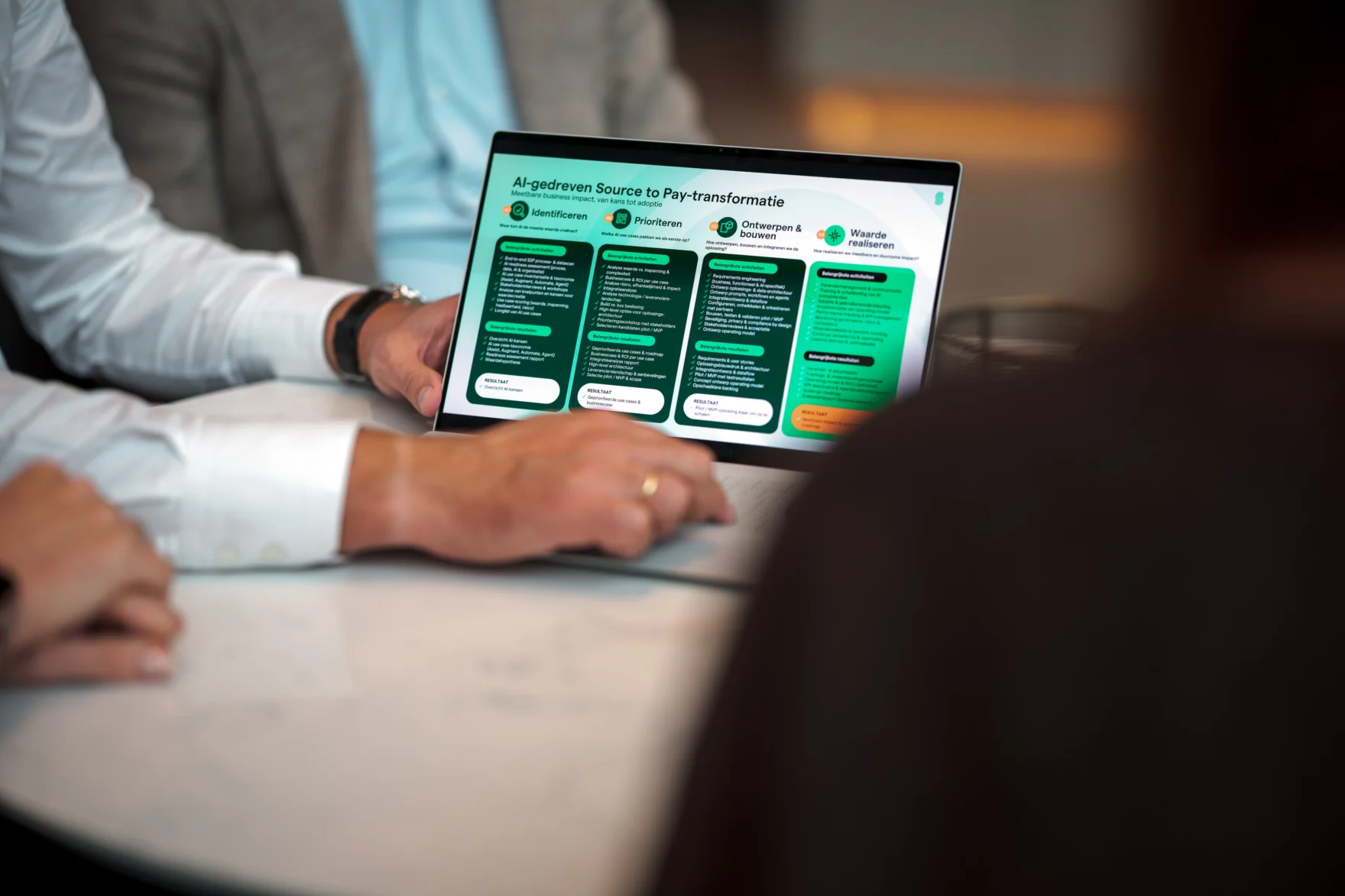
In recent years, the digitalisation of the procurement and payment process has gathered pace. What began with automating invoice processing and digitalising contract management is gradually developing into something fundamentally different: a Source to Pay chain that is increasingly driven by artificial intelligence. “AI can’t work miracles, but it does offer smart, scalable solutions to recurring problems in the procurement process,” says Paul van Rietschoten, managing director and co-founder of Spendlinq. “The challenge is simply to deploy technology in a way that adds value without increasing your organisation’s complexity.”
That calls for nuance. Although AI offers more and more possibilities – from smart sourcing to predictive spend analysis – there are pitfalls too. “Lots of organisations want to do something with AI, but have too little insight into the prerequisites,” says Paul. “You can build the most innovative model going, but if the underlying data is incomplete or unreliable, it will never get beyond a trial balloon.” Even so, the momentum to start with AI in Source to Pay now is strong. The technology is mature enough for practical applications, and its potential to make processes more efficient, more transparent and more secure is clear.
Practical applications
Take supplier selection as an example. Where the right party used to be found by hand, an AI model can now automatically make suggestions based on performance data, ESG criteria and risk profiles. “We see that AI is able to take dozens of variables into account at once – such as price, delivery reliability and contractual commitments – and use them to make recommendations that are well-founded and explainable,” Paul explains. “Not a black box, but clear insight into why a particular supplier comes out on top.”
The impact is also significant in contract analysis and risk management. With Natural Language Processing (NLP), AI solutions can scan legal documents for deviating terms, missing clauses or hidden risks. “We’ve seen a case where AI uncovered a penalty clause in an existing contract that had been completely overlooked. Insights like that are almost impossible to surface by hand.” According to Paul, this makes it possible to organise contract management in a far more proactive and consistent way.
In the operational ordering process, digital assistants are making more and more of a difference. Think of AI-driven procurement assistants that automatically draft purchase orders as soon as stock levels drop below a threshold, or that suggest alternative items when there are delivery problems. There are also applications where employees can simply place an order via a chat interface, after which the assistant automatically applies the right supplier, contract terms and ordering rules. “This doesn’t just reduce workload, it also leads to much more consistent ordering patterns,” says Paul. “Applications like these help organisations order faster, smarter and, above all, with fewer errors – while keeping central control and compliance.”
Opportunities for Accounts Payable
Paul also sees major opportunities for automation with AI within Accounts Payable (AP). “Think of automatically recognising, classifying and matching incoming invoices, including detecting deviations such as price differences or missing order references. AI can learn from earlier corrections and so get better and better at predicting the correct processing,” Paul explains. Self-learning workflows are also increasingly used to route invoices automatically to the right budget holder or department. As a result, processing times drop dramatically and the number of manual actions falls sharply – leading to more control, faster payments and a firmer grip on working capital.
Pitfalls
But there are concerns too, and rightly so. AI isn’t neutral, and it only works as well as the data you feed it. Paul is clear about this: “The biggest pitfall is thinking AI will do the work for you. In reality, you need to have your data landscape in order, set up governance and make sure your models are explainable. As a team, you have to be able to understand them and trust them.” Transparency and explainability are therefore not nice-to-haves but prerequisites. Especially in a procurement context where compliance, auditability and contractual commitments are central.
Another point of attention is adoption. AI doesn’t just change processes, it changes roles in the organisation too. “We find that employees can be hesitant. That’s why we often start with customers on small, manageable applications, such as automatic invoice recognition or contract validation. Once people see it works, trust grows naturally.” According to Paul, the greatest strength of AI lies in supporting the user, not replacing them. “We don’t believe in autonomous decision-making without human oversight. AI should provide insights, but the final choice remains with the professional.”
A changing market
The rise of AI also has consequences for the market of (Source to Pay) providers. For years, established players could build on a large customer base and robust but cumbersome platforms. Now there’s room for new entrants with modern, modular technology. “We see AI levelling the playing field”, says Paul. “An innovative player with a limited budget can suddenly develop functionality that was previously only within reach of large software houses.” Legacy systems often turn out to be less agile: their architecture is hard to adapt to data-driven or learning models. As a result, they risk being overtaken technologically – not despite, but because of their history. For customers, this means that reassessing the technological foundations of their Source to Pay landscape is becoming increasingly relevant. “The question isn’t just what a system can do today, but whether it can adapt to tomorrow”, says Paul. “Spendlinq follows these market shifts closely and sees it as its role to advise organisations independently and with expert knowledge on these choices.”
Vision for the future
He sees the future as promising, provided it’s approached realistically. “AI is going to fundamentally change the Source to Pay landscape. Think of self-learning processes that continuously optimise, or intelligent assistants that prepare negotiations based on market dynamics. But that won’t happen overnight.” According to Paul, getting there takes more than technology alone. Think of a robust data architecture and clear roles and responsibilities. But above all: a vision of how procurement adds value to the organisation.
A clear goal
Spendlinq plays a guiding role here. Not as a supplier of ready-made AI products, but as a substantive sparring partner that helps you deploy technology in a way that fits the context of your organisation. “Together with customers, we look at the maturity of their processes, the quality of their data and where AI can really contribute. Sometimes that’s an AI solution, sometimes it’s clearing up the basics. We believe in small steps, but with a clear goal.”
The goal is a Source to Pay landscape in which technology delivers not only speed and efficiency, but also insight, control and strategic advantage. “If you deploy AI the right way, you can turn procurement into a proactive, data-driven discipline that doesn’t just record after the fact, but looks ahead and creates value.”
Paul concludes: “AI in Source to Pay isn’t a revolution, it’s an evolution. And as with any evolution, it’s not the biggest or fastest organisations that survive, but those that adapt best. And that starts with insight, not with the tools.”